


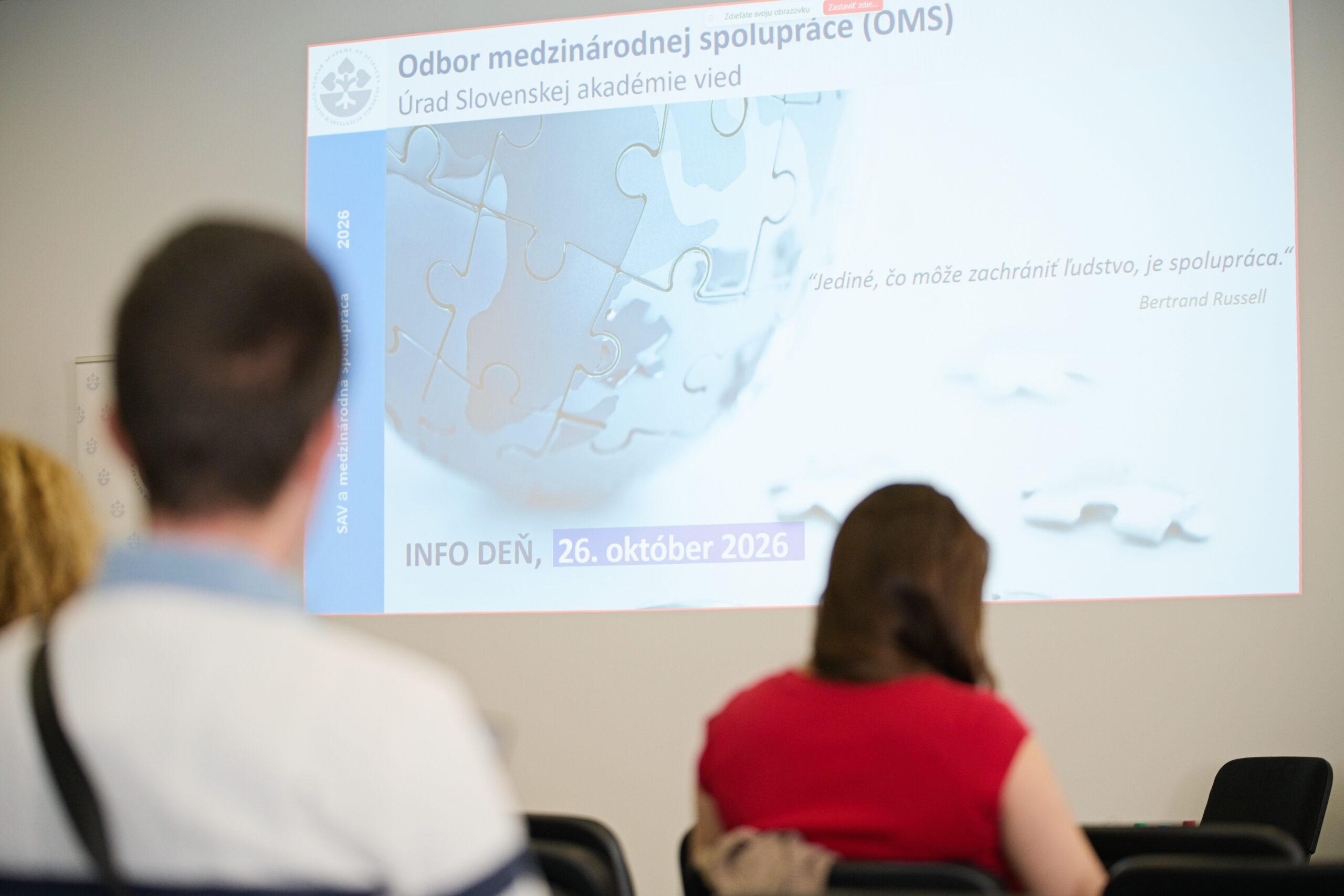
SAS researchers learned about opportunities for international cooperation and project funding at the INFO DAY organized by the Department of International Cooperation of the Office of SAS. The event took place at the Institute of Virology of the Biomedical Research Center SAS on 26 October 2026.
The INFO DAY was opened by Mgr. Zuzana Panczová, PhD., Vice-President of SAS for International Relations, who oversees the Academy’s international cooperation agenda. The aim of the event was to introduce researchers from SAS organizations to funding opportunities available through Mobility Programmes, the Open Partnership Programme, the Excellent Research Support Scheme, European Partnerships, Joint Research Projects (JRP), and EIG CONCERT-Japan.
During the presentation, the main activities of the Department of International Cooperation were introduced, including the work of its two divisions: the Bilateral Cooperation Unit and the Multilateral Projects Unit. The programme also addressed the increasingly important topic of research security, which has gained significant European and international relevance in recent years.
The second part of the event featured presentations by five successful coordinators and participants of international projects: RNDr. Róbert Kanka, PhD. from the Institute of Landscape Ecology SAS, representing the Biodiversa+ initiative; Mgr. Martina Gáliková, PhD. from the Institute of Zoology SAS, who shared her experience with the Seal of Excellence scheme; Dr. Domenico Pangallo, DrSc. from the Institute of Molecular Biology SAS, who presented projects funded through JRP NSTC and EIG CONCERT-Japan; Mgr. Božena Smolková, PhD. from the Cancer Research Institute, Biomedical Research Center SAS, who discussed her experience with TRANSCAN; and Mgr. Adriana Hvízdošová Annušová, PhD. from the Centre for Advanced Materials Application SAS, who presented a project supported by FLAG-ERA.
The speakers shared valuable insights, lessons learned, and practical recommendations gained through the preparation and implementation of international projects and collaborations. Their presentations highlighted several key factors contributing to successful international cooperation, including scientific excellence and the complementarity of partner teams, the development of trust and long-term international partnerships, flexibility in addressing project challenges, the involvement of early-career researchers, and the realistic definition of project objectives and expected outcomes.
We kindly invite you to complete a short survey on international cooperation. Your feedback is greatly appreciated and will help us further improve the quality of our services and support.